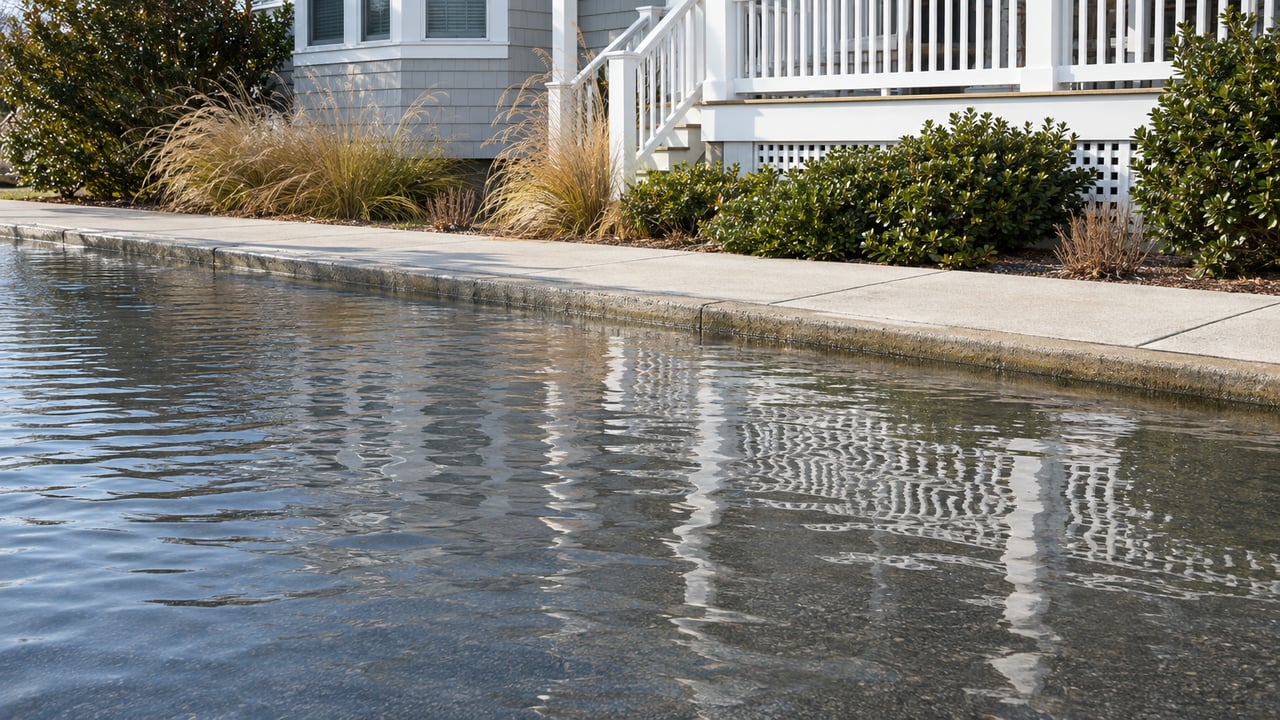
The photo that ran with OCNJ Daily's story shows floodwater threatening a car at 48th Street and Central Avenue during September's coastal storm. That storm ran from Friday, Sept. 25, through Sunday, Sept. 27. It peaked at 7.6 feet mean lower low water on Saturday morning's high tide, the fourth-highest reading ever at the Great Egg Harbor Bay station, according to the National Weather Service as reported by the Ocean City Sentinel. Gov. Mikie Sherrill declared a state of emergency for Atlantic and Cape May counties, among others.
About six weeks after the storm, City Council introduced an ordinance aimed at what happens when a car moves through that water.
What the Draft Says
Council passed Ordinance No. 26-10 on first reading on Nov. 5. According to the city's notice, it will be considered for adoption after a public hearing on Thursday, Nov. 19, at 6 p.m. in Council Chambers at City Hall. It takes effect only after final adoption and publication. The draft would add Section 4-45 to the city's Administrative Code and define a flooded roadway as any part of a public street or right-of-way with water "exceeding six inches" deep. On a flooded roadway, no one could operate a motor vehicle "in a manner that casts or discharges a wave or wake that carries beyond the edge of the street or curb line."
The penalty clause reads:
"For the purposes of a prosecution under this article, it shall not be a defense that the wave or wake that was created by operation of a motor vehicle on a flooded roadway did not cause actual damage to public or private property."
Penalties would run up to $1,250 in fines, up to 90 days in jail, or both. The ordinance's own preamble says Council wants to prohibit these wakes "without requiring proof of actual property damage to establish a violation."
City Solicitor Dorothy McCrosson told Council she was surprised a shore town this exposed to coastal flooding didn't already have such a rule. "But it's certainly overdue," she said, according to OCNJ Daily.
September Showed Who Pays for a Wake
Mayor Jay Gillian proposed the ordinance after what he called "reckless driving" by joyriding motorists who sped through flooded neighborhoods during the September storm, OCNJ Daily reported. He said the rule will remind drivers that "they have to be careful with other people's property."
Councilman Keith Hartzell, who owns property on Asbury Avenue downtown, described drivers zipping through the water and sending wakes into stores. He was one of the people who took the complaint to the mayor. He also put a number on the cost to drivers: the city towed between 50 and 70 cars stuck in floodwater that weekend.
The mayor's post-storm remarks, reported by the Ocean City Sentinel, connected the same two costs. Police stopped many vehicles at the height of the flooding and told anyone not answering an emergency to go home. "Driving during these flooding events poses a danger not only to the drivers and their vehicles, but also to properties damaged by their wake," Gillian said.
The Sentinel also carried a warning that applies once the water recedes. Police and fire crews answered a handful of lithium-ion battery fires in electric vehicles. Gillian cautioned that any EV, e-bike, scooter or battery-powered tool that has been submerged in or damaged by salt water can still catch fire.
Sea Isle City Drew Its Line Somewhere Else
The OCNJ Daily coverage noted that Ocean City's draft follows laws already passed in other shore towns. Sea Isle City adopted its own in 2019. Read side by side with Sea Isle's current traffic code, the two rules use the same water depth and the same penalties but measure the wake differently.
| Ocean City Ordinance No. 26-10, hearing Nov. 19 | Sea Isle City code | |
|---|---|---|
| When a street counts as flooded | Water exceeding six inches | Water exceeding six inches |
| Wake measure | Beyond the edge of the street or curb line | Exceeds six feet |
| Maximum fine | $1,250 | $1,250 |
| Maximum jail term | 90 days | 90 days |
What the City Already Asks You to Do Before the Tide
The ordinance would add a penalty. The city's existing flood guidance already covers the same ground, and it puts the work hours before high tide. The OEM advisory issued Jan. 30, 2026, ahead of a predicted 5.8-foot crest that the city called "minor" coastal flooding, laid out the routine in a few lines.
- Watch the crest time. The advisory gave the predicted crest at the Ninth Street Bridge on the bay side, down to the hour. The city's tide and flood level page lets you check a forecast against recent and historic levels on the same scale.
- Move the car early. The advisory told residents to move vehicles to safe places "well in advance" of high tide. It noted that streets closer to the beach, including Central and Wesley avenues, typically sit higher, and it said parking was free at all municipal lots for that event.
- Stay off water-covered streets. "Never drive on any street covered by water," it read, and don't go around barricades on flooded streets.
- Use the right number. The advisory listed 911 for police and fire emergencies and 609-399-9111 for non-emergencies.
Advisories like that one reach residents who sign up through the city's Alert Me page. National Weather Service advisories and watches go out by email, and warnings can come by phone, text or email through CodeRED. Hartzell's advice to Council was simpler. "There are dry roads. Please just go look for a dry road, because you will find one," he said, according to OCNJ Daily. He suggested the city pair the ordinance with an education campaign about which streets stay dry.
The Streets Themselves Are Being Rebuilt Around the Same Problem
The proposed ordinance addresses wakes on flooded streets. The city's capital work is aimed at how long streets stay flooded. In September, Gillian said every pumping station worked through the storm, and without them, water at that level "would have taken days to drain." The newly elevated Roosevelt Boulevard stayed above the floodwater and served as a reliable evacuation route. High-water rescue vehicles carried patients out of flooded areas to EMS teams in Upper Township under a mutual aid agreement.
The city's capital project list shows more of that work planned for this winter and beyond:
- 19th Street to 26th Street flood mitigation: drainage improvements and two new pumping stations in the corridor between Bay Avenue and West Avenue, scheduled for Fall 2026 to Spring 2027.
- Raised intersections on West Avenue: at 35th, 36th, 37th, 43rd, 44th and 45th streets, to improve drainage and end ponding at the intersections. Planned completion is Dec. 21, 2026.
- Ocean City Homes flood mitigation: two pumping stations and drainage improvements in the bayside neighborhood between 49th Street and Safe Harbor Drive, with construction expected to start in Fall 2027.
Residents can help too. The city's drainage maintenance page asks people to report any catch basin that doesn't seem to drain properly to Community Operations at 609-399-6111, and notes that city ordinances prohibit putting leaves, grass clippings, litter or other debris in gutters and drainage ways.
The timing of the vote lines up with the weather. In the same Sentinel coverage, NOAA notes that nor'easters are most common from November through March. Steve Hafner of Stockton University's Coastal Research Center warned that this winter's expected El Niño could bring more and stronger coastal storms to the mid-Atlantic.
One more note for anyone driving off the island through mid-December. NJDOT is running weekday single-lane closures in both directions on the Route 52 causeway from 7:30 a.m. to 3:30 p.m. through Dec. 11 for a lighting rehabilitation. The closures pause Nov. 23 through Nov. 27 and pick up again Nov. 30, and at least one lane stays open in each direction.
This post is general information about a proposed local rule, not legal advice. If you have a question about how it applies to you, check the adopted ordinance and talk to an attorney.
At The Anchor Group, we follow Ocean City's flood ordinances and drainage projects block by block, because they shape how a shore home holds up from one storm season to the next. If you'd like to know what the pumping station work or the West Avenue intersections mean for your street, get in touch, or start with a free home valuation.